
Three Manufacturers, Three Breaches, One Week: What It Means for Your Business
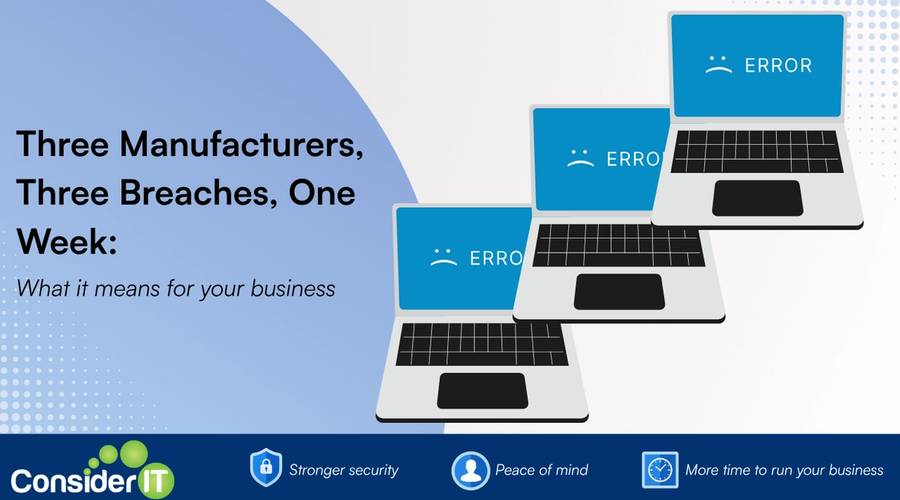
If you needed a reminder that no manufacturer is too big, too established, or too well resourced to be a target, this week delivered three of them at once.
A major Apple and Tesla supplier confirmed hackers had walked off with hundreds of gigabytes of confidential data. A Japanese motor manufacturer is being held to ransom for $2 million. And new reporting has confirmed what many suspected all along about the cyberattack that brought one of the world's most recognisable car brands to a standstill last year. It was Russian hackers.
None of these companies are small. All of them got hit anyway. Here is what happened, and why it matters just as much to a Perth manufacturer running fifteen staff as it does to a global giant.
Tata Electronics: 630GB stolen, Apple and Tesla data exposed
Tata Electronics builds a huge chunk of the world's iPhones. It is one of Apple's largest manufacturing partners and also supplies Tesla. Earlier this year, a cybercrime group calling itself World Leaks broke into Tata's systems and walked away with more than 630GB of data across some 200,000 files.
What got leaked wasn't just internal admin. It included component designs, manufacturing specifications, and details of parts for unreleased Apple products, alongside documents referencing Tesla vehicle components. There were also employee passports and internal emails in the mix.
Tata says the breach did not affect production. But the reputational damage is done, and the leak has pulled back the curtain on exactly how exposed a supply chain can be when one link in the chain gets compromised. Attackers didn't need to breach Apple or Tesla directly. They only needed to breach their supplier.
Nidec: hit twice in 18 months, now facing a $2 million demand
Nidec is one of the world's largest manufacturers of electric motors, the kind that end up in everything from smartphones to elevators to electric vehicles. A ransomwareMalware that locks up your files and demands a payment to unlock them. Good backups are your best defence. group calling itself Blackfield has claimed an attack on Nidec's Taiwanese subsidiary and is demanding $2 million to delete data it says it stole, giving the company just over two weeks to respond.
This is not Nidec's first rodeo. Back in October 2024, a different Nidec division was hit by ransomware, with two separate gangs trying to extort the company at the same time. Being targeted once clearly did not make Nidec immune to being targeted again.
That is a pattern worth sitting with. Paying, negotiating, or recovering from one attack does not put a company on some kind of "already been hit" exemption list. If anything, a known victim can look like an easier repeat target.
Jaguar Land Rover: the most damaging cyberattack in UK history, now linked to Russia
Back in August 2025, Jaguar Land Rover was hit by a cyberattack that shut down production across its UK factories for around five to six weeks. The damage was so severe that the UK government stepped in with a £1.5 billion support package, and the total hit to the British economy has been estimated at £1.9 billion, making it the most financially damaging cyberattack in UK history.
At the time, a loose group calling itself Scattered Lapsus$ Hunters claimed responsibility. But new reporting from the New York Times, based on people close to the investigation, has linked the core attack to Russian hackers. Investigators are still working out whether the group was acting directly for the Russian state, operating independently, or somewhere in between.
What stands out is how they got in. Reports point to social engineeringTricking people rather than hacking machines, by playing on trust, urgency or fear to gain access or information., phishingFake emails or messages that trick you into giving up passwords or clicking dangerous links by pretending to be someone you trust. emails and phone calls used to trick staff into handing over credentials, rather than some highly sophisticated technical exploit. The most damaging cyberattack in British history didn't start with elite hacking. It started with someone believing a phone call.
The thread running through all three
These are three very different companies, in three different countries, hit by three different attackers. But the pattern is the same one we talk about with our own clients constantly.
Manufacturing is a prime target because production downtime is expensive, supply chains are deeply interconnected, and a breach anywhere in the chain can ripple out to every business connected to it. Attackers know that a manufacturer under pressure to keep the line running is more likely to pay up quickly.
And the way in is rarely a movie-style hack. It is a stolen password, a convincing phone call, a legacy systemOlder software or hardware still in use but no longer well supported, which can become a risk. nobody got around to patching, or a supplier with weaker defences than the business they serve.
Why this matters if you are not a global manufacturer
If you run a trade, construction, or manufacturing business here in Perth, it is easy to look at these stories and think they belong to a different league altogether. They don't.
You are just as connected to your own suppliers, clients, and software vendors as Tata is to Apple. A compromised supplier, a weak password, or an untrained staff member can open the door regardless of whether your business turns over $17 billion or $1.7 million.
The businesses that come through incidents like these in the best shape are the ones who had the basics locked down well before anything went wrong. Multi-factor authenticationA second check on top of your password, such as a code on your phone, that stops most account break ins.. Staff who know what a suspicious phone call sounds like. Backups that actually work when you need them. A plan for what happens in the first hour after something goes wrong, rather than working it out on the fly.
Where to start
You don't need a $17 billion budget to get your defences right. You need to know where the gaps actually are.
If you would like a clear, plain English picture of where your business stands, book a free Rapid IT Analysis with our team. We will walk through the essentials with you and show you exactly where you are exposed, no jargon, no scare tactics, just a straight answer.
References
- Tata Electronics confirms cyberattack after alleged Apple, Tesla documents appear online, The Record: https://therecord.media/tata-electronics-confirms-cyberattack
- Apple iPhone 18 Pro secrets leaked in Tata Electronics hack: What we know, Al Jazeera: https://www.aljazeera.com/news/2026/6/30/apple-iphone-18-pro-secrets-leaked-in-tata-electronics-hack-what-we-know
- Security Breach at Tata Electronics Affects Apple, Tesla, and Other Technology Giants, CPO Magazine: https://www.cpomagazine.com/cyber-security/security-breach-at-tata-electronics-affects-apple-tesla-and-other-technology-giants/
- Blackfield ransomware asks Nidec Corporation for $2 million ransom, BleepingComputer: https://www.bleepingcomputer.com/news/security/blackfield-ransomware-asks-nidec-corporation-for-2-million-ransom/
- Japanese insurer, brewer, manufacturer and telecom disclose cyber breaches, The Record: https://therecord.media/japan-cyber-breaches-aflac-sapporo-nidec-kddi
- Russian Hackers Accused of Destructive Attack on Jaguar Land Rover, Infosecurity Magazine: https://www.infosecurity-magazine.com/news/russian-hackers-destructive-jaguar/
- Russian hackers were behind $2.5B hack of Jaguar Land Rover: Report, TechCrunch: https://techcrunch.com/2026/06/26/russian-hackers-were-behind-2-5-billion-hack-of-jaguar-land-rover-report/
- Jaguar Land Rover cyberattack, Wikipedia: https://en.wikipedia.org/wiki/Jaguar_Land_Rover_cyberattack
Was this useful?
Enjoyed this article? Join our newsletter for more.
We respect your inbox. Unsubscribe anytime.